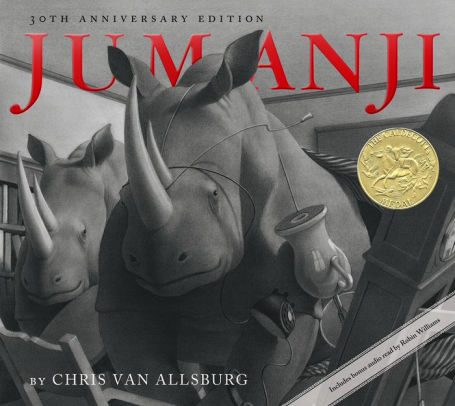
Allsburg, C. V., & Williams, R. (2011). Jumanji. Boston: Houghton Mifflin Books for Children
Summary:
Over thirty years ago, Peter and Judy first found the game–Jumanji–with the instructions that once the game is started, it must be finished or it will go on forever–and it was then, with this same wonderment, readers found Jumanji, too. Since its original publication, Jumanji has been honored with many awards, including the Caldecott Medal, and in 1996, the surreal story was adapted to fit the big screen for the first time. Retrieved November 27, 2019.
https://avrl.catalogue.library.ns.ca/Record/1130329/Excerpt
Age Level: 6-9
Justification: Whether in the context of an author study of Chris Van Allsburg or studied on its own, Jumanji is full of teachable ideas for students of all ages. Both the pictures and the text are packed with details that invite the reader into the world of the story. Even young students can be asked to notice these details and discuss them. Standard RL.2.3 states that students will describe how characters in a story respond to major events and challenges. Students can recall the major events that happened in the story and be asked to try adding believable dialogue to their own stories. Or children can be encouraged to develop their reading fluency by reading the dialogue out loud with expression.
English Language Arts Standards: Writing, Retrieved from Common Core State Standard Initiatives on November 27, 2019: http://www.corestandards.org/ELA-Literacy/
Review: “The Garden of-Abdul Gasazi), which robs the book of a contrast between the normal, everyday and the macabre; (2) his freeze-dry surrealism, which renders the turbulence as a static charade, or tableau; and (3) the paradox that imagined horror is more skin-prickling than horror seen—with a child’s mouth agape. Van Allsburg’s artistic skill seems largely confined to the devising of special effects—these largely dependent, in turn, on oversize close-ups and dramatic angles. Once their shock-value wears off, these are boring pictures—with no feel in particular (down to the inappropriately babyish toys) for a child’s world.” Kirkus Reviews 2019
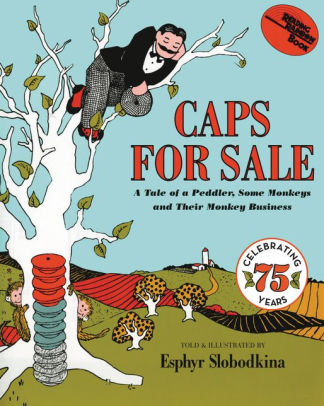
Slobodkina, E. (2015). Caps for sale: a tale of a peddler, some monkeys and their monkey business. New York: HarperCollinsPublishers.
Summary:
Caps for Sale is a timeless classic beloved by millions…one of the most popular picture books ever published! Children will delight in following the peddler’s efforts to outwit the monkeys and will ask to read it again and again. Caps for Sale is an excellent easy-to-read book that includes repetition, patterns, and colors, perfect for early readers. This tale of a peddler and a band of mischievous monkeys is filled with warmth, humor, and simplicity and also teaches children about problem and resolution. Retrieved November 27, 2019
https://avrl.catalogue.library.ns.ca/Record/141969/Excerpt
Age Level: 3-7
Justification: This book is filled with colorful images that will grab the attention of young readers. It is a very interesting tale that readers will continuously pick up and read again. In a classroom setting a teacher could use this book to have students be able to identify story elements including setting, characters, problem and solution. Standard RL.1.3 states that students will describe characters, settings, and major events in a story, using key details. The standard can be used with the book by having the students examine the front cover and having them make inferences, as well as making predictions over what the story might be about.
English Language Arts Standards: Writing, Retrieved from Common Core State Standard Initiatives on November 27, 2019: http://www.corestandards.org/ELA-Literacy/RL/1/3/
Review: The late Slobodkina’s friend and mentee, Sayer, brings back Caps for Sale’s monkeys and peddler in a new story about the characters’ fractious but ultimately positive relationship. Endnotes explain that Sayer used characters and other illustrative elements from Slobodkina’s body of work to create new pictures, with text inspired by ideas they’d discussed over the years. In this story, the peddler is distressed because the monkeys have occupied a tree outside his house. Exasperated, he goes to his friend Essie’s house for advice, and the monkeys (of course) follow him. Essie is a painter based on Slobodkina herself, and she’s depicted with one of the artist’s most famous fine-art paintings on her easel. She counsels patience with the monkeys. That night, the peddler visits an ill friend instead of working. His concern that he won’t have caps to sell the next day is resolved by the monkeys, whose “mindful” observation from their tree has taught them how to make new caps to sell. Readers hoping for more of the elemental charm and fizzy mischief of Caps for Sale will be disappointed. The text is earnest and overlong, many illustrations are too busy, and furthermore it’s unclear exactly how Sayer manipulated Slobodkina’s original art. Several compositions are decidedly awkward, as is the visual pacing. Kirkus Reviews 2019.
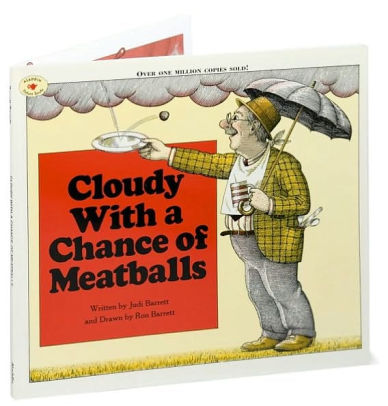
Roettger, D., & Barrett, J. (1987). Cloudy with a chance of meatballs. Logan, IA: Perfection Form.
Summary:
The tiny town of Chewandswallow was very much like any other tiny town, except for its weather, which came three times a day—at breakfast, lunch, and dinner! Life for the townspeople was delicious, until the miraculous food weather took a turn for the worse. The food got larger and larger, and so did the portions. The flood of huge food caused chaos, and the people feared for their lives. Something had to be done…before it was too, late! Retrieved November 27, 2019
Age Level: 4-8
Justification: Cloudy With a Chance of Meatballs is a fun way to kick off your weather unit. This book puts a fun twist on weather patterns, that will make the students interested. Standard K-ESS2-1 states that students will use and share observations of local weather conditions to describe weather patterns over time. This standard can be used with the book to have the students determine real and fake weather patterns, This can be covered over a whole unit with different activities that the students can participate in.
Science Standards: science, Retrieved from Common Core State Standard Initiatives on November 27, 2019: https://www.nextgenscience.org/pe/k-ess2-1-earths-systems
Review: A flying pancake at breakfast triggers Grandpa’s bedtime story set in the far-off land of Chewanswallow, where the food comes out of the sky and “”whatever the weather served, that was what they ate.”” Most of the book consists of nothing more than elaborations on this conceit, with running menu information decked out in weather report terminology, but Judi Barrett’s examples are nutty enough so that kids won’t tire of the gag–even though Ron Barrett’s flippy pop cartoons are too literal to enlarge it. The plot thickens with the maple syrup, and at last the portions grow so large that the people are being bombarded and buried by food–and so they all sail off on peanut-butter sandwiches to a land where food is purchased at the supermarket. A dubious improvement perhaps, but Grandpa’s imaginings are very close to a little kid’s funny bone–which everyone knows is located somewhere along the intestinal tract. Kirkus Review 2019
https://www.kirkusreviews.com/book-reviews/judi-barrett-8/cloudy-with-a-chance-of-meatballs/
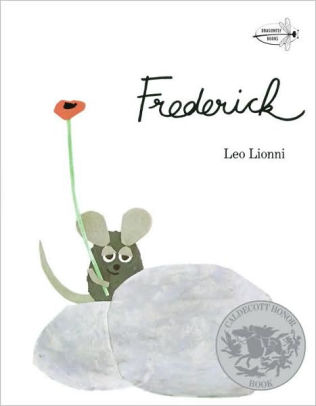
Lionni, L., Lionni, L., & Fuchs Günter Bruno. (2017). Frederick. Weinheim: Beltz & Gelberg.
Summary:
Winter is coming, and all the mice are gathering food . . . except for Frederick. But when the days grow short and the snow begins to fall, it’s Frederick’s stories that warm the hearts and spirits of his fellow field mice. Winner of a 1967 Caldecott Honor, Frederick has been cherished by generations of readers. Retrieved November 27, 2019
https://www.barnesandnoble.com/w/frederick-leo-lionni/1100831326?ean=9780394826141
Age Level: 4-8
Justification: Students love using the images brought to life to describe the main characters and key details. Introducing younger students to expressive language and poetry can be tricky. Students can usually identify with limericks and rhymes, but creating them on their own is difficult. This book will provide students with examples of poetry. Standard RF.4.4 states that students will read with sufficient accuracy and fluency to support comprehension. Using this book will allow students to practice proper fluency and reading a grade-level text with purpose and understanding will aid student comprehension.
http://www.corestandards.org/ELA-literacy/RF/4/4/
Review: ” Frederick and his family of mice are gathering the supplies that they are going to need for survival through winter. While the other mice were working hard gathering ¿corn and nuts and wheat and straw,¿ Frederick spends time gathering sunrays, colors, and words. When winter comes the mice all run to ¿their hideout in the stones.¿ At first the mice family was fine. But after a while they began to get low on food and supplies, but winter wasn¿t over. Then they turn to ask ¿what about your supplies, Frederick?¿ Leo Lionni lived in Tuscany, Italy until he passed away in October 1999. He is both an author and an illustrator. I thought this book has good use of black and white pictures. The story line also taught that people have different ways of dealing with situations, and that is okay. He is well known throughout the country for both his illustrations and stories. In 1959 he wrote his first book for his grandchildren on a dull train road. Leo Lionni has won four Caldecott Medal Awards, including Frederick.” B&N Reviews 2019
https://www.barnesandnoble.com/w/frederick-leo-lionni/1100831326?ean=9780394826141
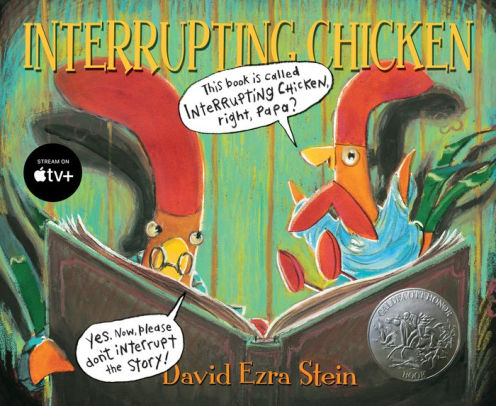
Stein, D. E. (2019). Interrupting chicken. Somerville, MA: Candlewick Press.
Summary:
It’s time for the little red chicken’s bedtime story — and a reminder from Papa to try not to interrupt. But the chicken can’t help herself! Whether the tale is Hansel and Gretel or Little Red Riding Hood or even Chicken Little, she jumps into the story to save its hapless characters. Now it’s the little red chicken’s turn to tell a story, but will her yawning papa make it to the end without his own kind of interrupting? The charming 2011 Caldecott Honor Book is available in paperback for the first time. Retrieved November 27, 2019.
https://www.penguinrandomhouse.com/books/204791/interrupting-chicken-by-david-ezra-stein/
Age Level: 4-8
Justification: This book can be presented to a classroom where there is a lot of disruption such as: calling out, talking while the teacher is talking, etc. A teacher could use this book to serve as a lesson to those who call out and disrupt class. This could also be used as a set of guidelines/rules for the classroom. Standard RL.K.10 states that students will actively engage in a group reading activities with purpose and understanding. This could be conducted as a whole group on the carpet. During the reading of the book, the teacher could ask questions to engage students on right and wrong decisions.
http://www.corestandards.org/ELA-literacy/RL/K/10/
Review: ” Despite repeated vows to stop interrupting, a little red chicken can’t resist jumping in to cut her Papa’s bedtime tales short with plot giveaways—“DON’T GO IN! SHE’S A WITCH!”—and truncated, happy endings. Endowing his poultry with flamboyantly oversized combs and wattles, Stein switches between stylish but cozy bedroom scenes and illustrations from each attempted story (into which little red chicken forcibly inserts herself) done in a scribbly, line-and-color style reminiscent of Paul Galdone’s picture-book fairy tales. Having run out of stories, exasperated Papa suggests to little red chicken that she make one up for him, which she does in laborious block print on lined paper, complete with crayoned stick-figure illustrations. Closing with an intimate snuggle after Papa instantly dozes off, this tender iteration of a familiar nighttime ritual will be equally welcomed by fond parents and those children for whom listening to stories is anything but a passive activity. (Picture book. 4-6).” Kirkus Reviews 2019
https://www.kirkusreviews.com/book-reviews/david-ezra-stein/interrupting-chicken/
 Tyler's Annotated Bibliography Blog