
Bryant, J., & Sweet, M. (2014). The right word Roget and his thesaurus. Grand Rapids: Eerdmans Books for Young Readers.
Summary:
For shy young Peter Mark Roget, books were the best companions — and it wasn’t long before Peter began writing his own book. But he didn’t write stories; he wrote lists. Peter took his love for words and turned it to organizing ideas and finding exactly the right word to express just what he thought. His lists grew and grew, eventually turning into one of the most important reference books of all time. Retrieved November 27, 2019.
https://www.goodreads.com/book/show/20696727-the-right-word
Age Level: 7-18
Justification: This book is a perfect choice to have in a school library. In modern times, most students turn to the internet to look up words and their meanings, as well as antonyms and synonyms. In a classroom, this book would be perfect for a section on synonyms and antonyms and their distinction. Standard L.4.5 states that a student will demonstrate understanding of figurative language, word relationships, and nuances in word meanings. In a lesson, students learn about synonyms and antonyms through physical activity. The teacher calls out a series of commands. First, the students perform the synonyms and then they go through the same list of commands and the students have to perform the antonym. Students are engaged using psychomotor and cognitive skills.
corestandards.org/ELA-Literacy/L/4/5
Review: ” Born in London in 1779, Roget was plagued by lifelong setbacks. His father died early; his mother was unstable. Frequent moves and pronounced shyness engendered solace in books. Partial to classifying his knowledge and experiences, Peter composed his first book of lists by age 8. Inspired by the taxonomy of Swedish physician and botanist Linnaeus, teenage Peter studied medicine in Scotland, eventually establishing a practice in London, and he worked on a book of word classifications, completing it in 1805 for his own reference. Roget lectured, invented (the slide rule and the pocket chess set) and, inspired by the publication of several contemporary, inferior books of lists, returned to his own. His Thesaurus, published in 1852 and nurtured by his descendants, has never gone out of print. Bryant’s prose is bright and well-tuned for young readers. She goes gently, omitting Roget’s darkest traumas, such as witnessing his uncle’s suicide. Sweet tops herself—again!—visually reflecting Roget’s wide range as a thinker and product of the Enlightenment. Injecting her watercolor palette with shots of teal, scarlet and fuchsia, Sweet embeds vintage bits (ledger paper, type drawers, botanical illustrations and more), creating a teeming, contemplative, playfully celebratory opus. Exemplary backmatter includes a chronology, author’s and illustrator’s notes, selected bibliography, suggested reading, quotation sources, and a photograph of one of Roget’s manuscript pages.” Kirkus Review 2019
https://www.kirkusreviews.com/book-reviews/jen-bryant/the-right-word/

Freedman, R. (1999). Lincoln: a Photobiography. Bt Bound.
Summary:
Abraham Lincoln stood out in a crowd as much for his wit and rollicking humor as for his height. This Newbery Medal-winning biography of our Civil War president is warm, appealing, and illustrated with dozens of carefully chosen photographs and prints. Russell Freedman begins with a lively account of Abraham Lincoln’s boyhood, his career as a country lawyer, and his courtship and marriage to Mary Todd. Then the author focuses on the presidential years (1861 to 1865), skillfully explaining the many complex issues Lincoln grappled with as he led a deeply divided nation through the Civil War. The book’s final chapter is a moving account of that tragic evening in Ford’s Theatre on April 14, 1865. Concludes with a sampling of Lincoln writings and a detailed list of Lincoln historical sites. Retrieved November 27, 2019
https://www.goodreads.com/book/show/106597.Lincoln
Age Level: 6-10
Justification: This book is for middle grade readers and the tone and vocabulary is perfect. This book gives students a deeper look into the Civil War and what had happened while President Lincoln was in office. The book could be used during a Civil War/social studies unit. Standard W.4.3 states that students will write narratives to develop real or imagined experiences or events using effective technique, descriptive details, and clear event sequences. In a social studies unit, the students can write letters to Abraham Lincoln and describe the events of the Civil War or how times have changed since his assassination.
corestandards.org/ELA-Literacy/W/4/3/
Review: ” I have definitely learn a whole bunch of facts about Abraham Lincoln that totally blew my mind. For example, did you know that his sister died when he was just eighteen years old. You know how devastating that could have been for Abraham but somehow that tall man stuck with it and stayed stong. At the point of me reading this photo biography, I had been learning about the Civil War and Abe Lincoln’s presidency which was one of the reasons I picked this book up; to learn more about the character I had previously been learning about. This book secured a lot of the facts that I had misconceived about, while learning about Abraham Lincoln. His life is just truly extraordinary and you will be amazed too if you read this mindbogglingly book. It is shocking to read about the life of a human that was born in the 19th century not just Abraham. There life is so much more different then we may have comprehended. Well, I hope that you enjoy this book as much as I did and that you will read it too.” Goodreads 2019.
https://www.goodreads.com/book/show/106597.Lincoln
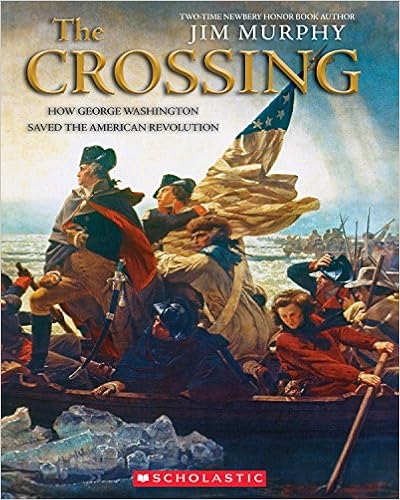
Murphy, J. (2016). Crossing: how george washington saved the american revolution. Place of publication not identified: Scholastic (Us).
Summary:
With his engaging and timeless narrative prose, two-time Newbery Honor Book author Jim Murphy tells the awe-inspiring story of George Washington’s glorious fight for an independent America. It is 1776, and George Washington and his army of rebellious American colonists are emboldened by its stunning victories over the British at Lexington and Concord. But now, the Americans face the threat of a brutal British retaliation. George Washington, who has little experience with a threat of this magnitude, is unanimously chosen as commander in chief in hopes he can unite the colonies. Britain’s army is massive and well trained. America’s is small and unruly. Retrieved November 27, 2019.
https://www.goodreads.com/book/show/7987310-the-crossing
Grade Level: 4-7
Justification: This book is for late elementary to middle grade readers and the tone and vocabulary is perfect. This book gives students a deeper look into the American Revolution and what had happened while George Washington was serving. The book could be used during a American Revolution/social studies unit. Standard W.4.3 states that students will write narratives to develop real or imagined experiences or events using effective technique, descriptive details, and clear event sequences. In a social studies unit, the students can write letters to George Washington and describe the events of the American Revolution or how times have changed since his death.
corestandards.org/ELA-Literacy/W/4/3/
Review: “Whereas purely chronological histories drag readers’ attention from one theater of war to another, Murphy concentrates on the troops directly under Washington’s command in the events leading up to the battles of Trenton and Princeton, so that each step or misstep is as riveting as if readers were following at the heels of ‘the old fox.'” School Library Journal 2019
https://www.amazon.com/Crossing-George-Washington-American-Revolution/dp/0439691877
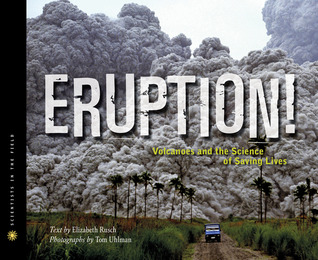
Rusch, E., & Uhlman, T. (2017). Eruption!: volcanoes and the science of saving lives. Boston: Houghton Mifflin Harcourt Books for Young Readers.
Summary:
At 11:35 p.m., as Radio Armero played cheerful music, a towering wave of mud and rocks bulldozed through the village, roaring like a squadron of fighter jets.” Twenty-three thousand people died in the 1985 eruption of Colombia’s Nevado del Ruiz. Today, more than one billion people worldwide live in volcanic danger zones. In this riveting nonfiction book—filled with spectacular photographs and sidebars—Rusch reveals the perilous, adrenaline-fueled, life-saving work of an international volcano crisis team (VDAP) and the sleeping giants they study, from Colombia to the Philippines, from Chile to Indonesia. Retrieved November 27, 2019.
https://www.goodreads.com/book/show/15814403-eruption-volcanoes-and-the-science-of-saving-lives
Age Level: 10-14
Justification: This book provides a closer look to volcanoes and the crews that go check them out. Students will learn about the efforts of the team to accurately forecast volcanic eruptions and the challenges they faced. Standard 4-ESS2-2 states that students will Analyze and interpret data from maps to describe patterns of earth’s features. In this unit students can assess existing knowledge by asking each student to draw a volcano, encourage students to show what is inside the volcano. Share drawings and discuss ideas.
https://thewonderofscience.com/4ess22
Review:
“Rusch (Mighty Mars Rovers, 2012) cranks up the pressure as she portrays scientists whose work requires getting entirely too close to active or soon-to-be-active volcanoes.
This entry in the Scientists in the Field series is highlighted by dramatic accounts of three massive modern eruptions: Colombia’s Nevado del Ruiz in 1985, Mount Pinatubo in the Philippines (1991) and Mount Merapi (2010) in Indonesia. Rusch follows members of the U.S. Geological Survey’s Volcano Disaster Assistance Program, the “first and only international volcano crisis team,” to those and other sites, providing plenty of maps, subterranean diagrams and photos of team members working both in labs and on site with local scientists for visual aids. She explains how volcanologists have learned to identify and evaluate the often ambiguous warning signs of impending disaster in time to make informed decisions about when and how far to evacuate nearby residents (not to mention themselves). Her descriptions, as well as Uhlman’s before-and-after photos will leave readers with vivid impressions of the massive destruction that lava bombs, pyroclastic flows and heavy rains of ash can, do and inevitably will wreak.
High-stakes science, portrayed in one of the scarier entries in this bar-setting series. (glossary, notes, bibliography, index) (Nonfiction. 10-14)” Kirkus Reviews 2019
https://www.kirkusreviews.com/book-reviews/elizabeth-rusch/eruption/

Ehlert, L. (2017). Eating the alphabet: fruits and vegetables from A to Z. NY, NY: Harcourt.
Summary:
While teaching upper- and lowercase letters to preschoolers, Ehlert introduces fruits and vegetables from around the world. A glossary at the end provides interesting facts about each food. Retrieved November 27, 2019.
amazon.com/eating-alphabet-lois-ehlert/dp
Age Level: 4-6
Justification: This book can be used it as a tool for younger children/students: letter identification (by sight or by sound). Each food is labeled in upper as well as lower case letters. Students can view the different colors and pair it with different fruits. This aids their word recognition skills and color identification skills. Standard RL.K.10 states that a student will actively engage in group reading activities with purpose and understanding. During the reading of the text, the teacher can ask the students questions pertaining to the different colors and fruits. The students will be able to differentiate colors, their sounds, and what fruits pair with them.
corestandards.org/ELA-Literacy/RL.K.10/
Review: ” With images as boldly conceived as those in her Planting a Rainbow, yet with subtly added textures that create far closer links between her art and the objects represented, Ehlert has produced an outstanding alphabet book. There are 75 fruits and vegetables here, which include the familiar as well as plenty that are mildly exotic (kumquat, radicchio). Page design is inspired, with the names printed in large type, in both upper and lower case, in an elegant face, sometimes vertically and sometimes horizontally. Notes on the species’ origins and uses are appended (xigua–the only non-English entry–is the Chinese name for watermelon). A beautiful, useful book.” Kirkus Reviews 2019.
https://www.kirkusreviews.com/book-reviews/lois-ehlert/eating-alphabet/
 Tyler's Annotated Bibliography Blog